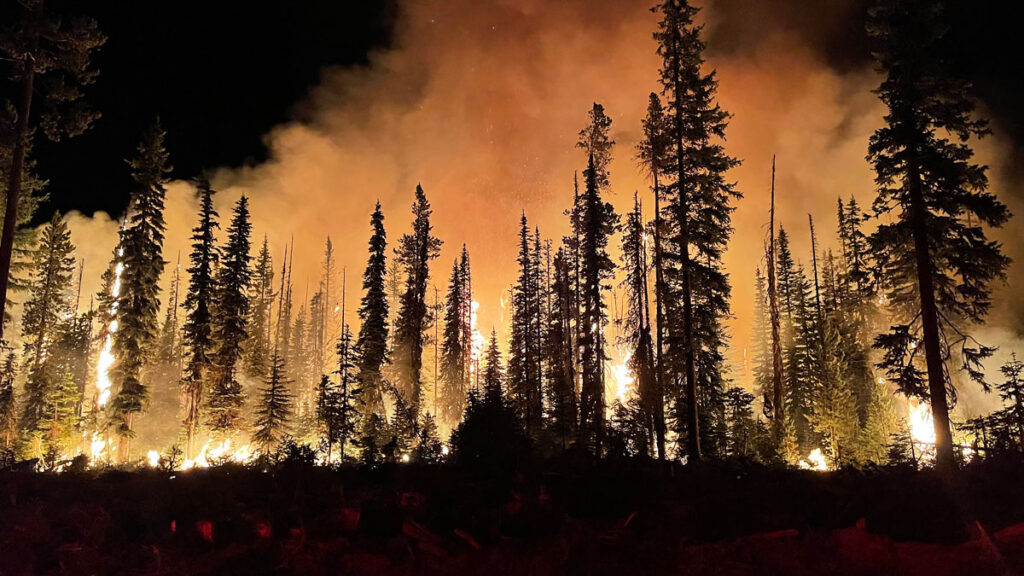
A warm, dry spring has pushed much of the western and southern United States into an above-normal wildfire outlook for the coming summer, according to a monthly forecast from the National Interagency Fire Center.
Most of the U.S. West Will Face Above-Normal Wildfire Risk This Summer.
The 1 May outlook projects the likelihood of significant wildland fires from May through August, using long-range forecasts from NOAA’s Climate Prediction Center, current precipitation and drought conditions, and the amount of burnable fuel on the landscape. The forecast defines significant fires as those that require a response from the National Interagency Fire Center. This year, 1,848,210 acres have already burned nationwide, nearly twice the average annual total over the past decade.
“It’s not necessarily a foregone conclusion that we’re going to have a really busy season, but everything is pointing that way,” said Jim Wallmann, a meteorologist with the U.S. Forest Service at the NIFC and one of the outlook’s authors.
The West is the main area of concern. In May, above-average fire potential is concentrated in eastern Arizona and western New Mexico, then shifts north and west as the season progresses. By June, the elevated risk extends into western Colorado and parts of the Pacific Northwest. In July and August, much of the Northwest — including Utah, Idaho, Oregon, Washington, and Northern California — is projected to face above-average significant fire potential.
The outlook points to two major drivers: unusually warm spring temperatures and a far-below-normal snowpack. Many western river basins have less than 20% of their normal snow, and some locations were already snow-free in March after early melting. Craig Clements, a meteorologist at San Jose State University’s Fire Weather Research Laboratory who was not involved in the outlook, said lower snowpack affects soil moisture later in the summer and, in turn, fuel moisture. Early melt also exposes pine needles, leaf litter, and other fuels that would otherwise remain buried under snow.
Southern California and the Sierra Nevada are exceptions within the West, with average significant fire risk expected through the summer because of higher-than-average precipitation earlier in the year.
Fire risk is also elevated in the Southeast. Florida is expected to remain above average through the end of August, and parts of southern Georgia, Mississippi, Louisiana, Arkansas, and the eastern halves of Virginia, North Carolina, and South Carolina are also forecast to face above-average significant fire potential. The outlook links that risk in part to drought, which is affecting both the Southeast and the West. As of 1 May, nearly 63% of the country was in drought, and 19% was in extreme or exceptional drought, according to the U.S. Drought Monitor.
The Midwest and Northeast are expected to stay near average from May through August, although northwestern Minnesota faces above-average potential in May. No part of the United States is projected to have below-average significant fire potential through the end of August.
There is still uncertainty in the forecast. A developing El Niño could change the picture, though scientists do not yet know exactly how. A strong El Niño could worsen drought in the Southeast, while in the Pacific it could affect hurricane activity in ways that might lower wildfire risk. It could also increase lightning in the Sierra Nevada, which would raise fire danger there. Clements noted that weather patterns can still shift and alter the outlook, and Wallmann said meteorologists will have a better sense of El Niño’s influence later in the summer.
For now, the message from fire forecasters is straightforward: conditions are leaning toward a busy season, even if the exact outcome is not yet fixed. Wallmann and Clements both urged people in higher-risk areas to stay aware of local conditions and think ahead about where they would go if a wildfire threatened their area.
Na poskytovanie tých najlepších skúseností používame technológie, ako sú súbory cookie na ukladanie a/alebo prístup k informáciám o zariadení. Súhlas s týmito technológiami nám umožní spracovávať údaje, ako je správanie pri prehliadaní alebo jedinečné ID na tejto stránke. Nesúhlas alebo odvolanie súhlasu môže nepriaznivo ovplyvniť určité vlastnosti a funkcie.
Funkčné
Vždy aktívne
Technické uloženie alebo prístup sú nevyhnutne potrebné na legitímny účel umožnenia použitia konkrétnej služby, ktorú si účastník alebo používateľ výslovne vyžiadal, alebo na jediný účel vykonania prenosu komunikácie cez elektronickú komunikačnú sieť.
Predvoľby
Technické uloženie alebo prístup je potrebný na legitímny účel ukladania preferencií, ktoré si účastník alebo používateľ nepožaduje.
Štatistiky
Technické úložisko alebo prístup, ktorý sa používa výlučne na štatistické účely.Technické úložisko alebo prístup, ktorý sa používa výlučne na anonymné štatistické účely. Bez predvolania, dobrovoľného plnenia zo strany vášho poskytovateľa internetových služieb alebo dodatočných záznamov od tretej strany, informácie uložené alebo získané len na tento účel sa zvyčajne nedajú použiť na vašu identifikáciu.
Marketing
Technické úložisko alebo prístup sú potrebné na vytvorenie používateľských profilov na odosielanie reklamy alebo sledovanie používateľa na webovej stránke alebo na viacerých webových stránkach na podobné marketingové účely.